SFMTA Board passes a two-year budget, but Muni service is at risk without additional funding
Transportation is vital to San Francisco’s livability, vitality and economic recovery. Now, Muni faces the largest budget deficit in its history. As one-time pandemic relief funding runs out, we face a budget deficit of $307 million that will grow to $430 million by 2030. Our balanced budget prioritizes protecting regular Muni and paratransit service in FY26-27, but a need remains for new funding. Learn about the Muni and street safety impacts at risk.
Learn more about the three sources of revenue that can bridge the budget gap.
The San Francisco City Charter requires that the SFMTA submit a two-year, balanced budget in even-numbered years. The budget should outline how the agency will allocate its operating and capital resources for the next two years.
The Budget
On April 21, 2026, the San Francisco Municipal Transportation Agency (SFMTA) Board of Directors approved a balanced two-year budget. The full budget includes a two-year operational budget of $1.5 billion for Fiscal Year (FY) 2026-2027 and $1.6 billion for FY2027-2028, and a two-year capital budget of $655 million in FY26-27 and $546 million in FY27-28. Learn more details by reviewing the materials from the SFMTA Board meeting for the budget approval.
View details on the approved budget
The FY26-27 and FY27-28 budget is the first step of a multi-year funding strategy to reduce costs and stabilize the SFMTA budget. It lays the groundwork for future operational and cost efficiencies. The long-term goal is to avoid significant cuts to Muni service and programs.
What's at Stake
The SFMTA faces the largest financial crisis in the agency’s history. Despite significant progress in identifying cost savings internally, more funding is required to help keep Muni and other transit services running. Without adequate funding, the SFMTA will be forced to make significant cuts to Muni services and programs beginning in FY 27-28.
- The elimination of up to 20 Muni routes, including hilltop and neighborhood routes, those on corridors with nearby service, and downtown express service
- Doubled wait times on Metro, Rapid and frequent routes, leading to more crowding and pass ups
- The reduction of evening service (9 p.m. to midnight) by up to 60%
- The reduction or elimination of historic service on our three cable car lines and F Market & Wharves streetcar line
- Less transit service for special events like Giants, Warriors and Valkyries games, Fleet Week and concerts in Golden Gate Park
- Fare discount programs eliminated or reduced
Learn more about the impacts to Muni and street safety without necessary funding.
Long-term Funding Strategy
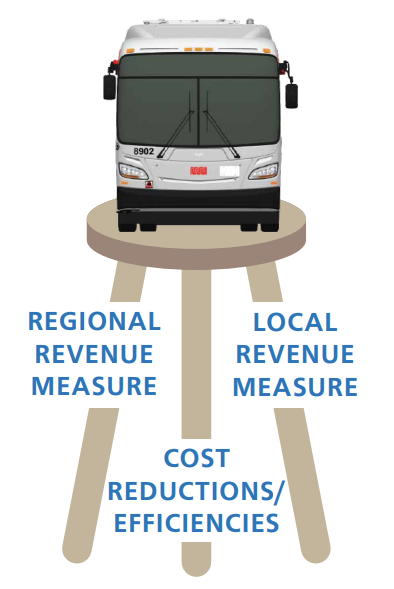
The SFMTA’s budget is balanced with a funding strategy that includes three sources of revenue to close our deficit, maintain current service and create a stronger future for Muni:
- Ongoing work to find efficiencies and cost savings
- Regional revenue measure – the Connect Bay Area Transit Initiative
- Local revenue measure – the Stronger Muni for All ballot measure
Learn more about the three sources of revenue that can bridge the budget gap.
Budget Development Process
To establish the two-year budget, SFMTA staff develops a proposed revenue and expenditure plan for the coming two-year cycle for Operating and Capital Budgets. The SFMTA Board of Directors discusses the budget over the course of numerous public board meetings. The budget is submitted to the Mayor by May 1 of each even-numbered year.
Community Engagement
From October 2025 to January 2026, the SFMTA deployed a city-wide survey to collect feedback on the community's transportation priorities going into the two-year budget cycle. We received more than 5,000 responses, and this input directly informed the development of our budget.
The SFMTA hosted three open house opportunities for the community to come together and ask questions as well as provide additional input.
We advertised and held the legislative meetings where the SFMTA board heard the final budget proposal and voted on its approval.