
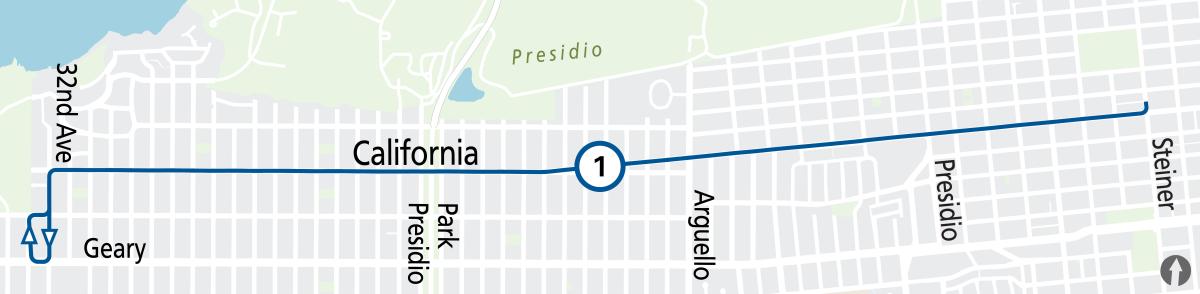
The California Street Transit and Safety Project aims to improve the 1 California route from 33rd Avenue to Steiner Street. The project focuses on enhancing reliability, reducing travel times, increasing capacity, and improving accessibility and safety. Feedback from this survey will help us develop our initial proposal.
Пожалуйста, примите участие в нашем опросе.
¡Por favor, responda nuestra encuesta!
Vui lòng tham gia khảo sát của chúng tôi!

The 1 California is one of Muni’s busiest routes—but also one of the slowest. During rush hour, buses on the western part of the route, along California Street, travel at about 8 miles per hour on average. This part of California Street has also seen a high rate of injury collisions over the last five years and includes areas on the City’s High Injury Network, the 13 percent of streets accounting for 74 percent of the City’s severe and fatal traffic injuries. As part of the Muni Forward program, we’re looking at ways to improve reliability on the 1 California and make California Street safer for everyone. The project will focus on California Street between 33rd Avenue and Steiner Street, where the 1 California serves the street.
- Planning
Every day, nearly 20,000 riders use the 1 California to connect from the Richmond District to neighborhoods like Laurel Village, Pacific Heights, Nob Hill, Chinatown, the Financial District and the Embarcadero. The route plays a key role in moving San Franciscans east and west between the Outer Richmond and downtown, but is among the most crowded and often stuck in congestion.
The California Street Transit and Safety Project aims to make Muni faster and more reliable, improve comfort for people waiting for and getting on and off the bus, and improve safety for all who travel along California Street between 33rd Avenue and Steiner Street.
To meet our project goals, we will be working closely with transit riders, residents, merchants and other community members to understand the top priorities for improving California Street. Some of the improvements explored elsewhere in the city have included:
- Improving amenities at bus stops
- Widening sidewalks at bus stops to give Muni passengers more space and make boarding easier
- Adjusting traffic signal timing to give buses more green lights and help them stay on time
- Reviewing bus stop placement to reduce delay
- Improving curb management to reduce double parking and better support merchants and deliveries
- Adding traffic and pedestrian safety features
We are starting with a listening tour in 2026 to identify what’s working and what could be better. This feedback will help shape an initial set of concepts for improving the corridor that we’ll share in 2027 for refinements in partnership with community members before any proposals are brought to the SFMTA Board for review and approval.
Building on Past Improvements
We’re building on past efforts that have already made the 1 California more reliable and California Street safer.
Recent transit and safety improvement projects on the 1 California have included:
- In 2015, the SFMTA added transit signal priority (TSP) on the 1 California to help the bus move more smoothly across 27 intersections. TSP works by adjusting traffic signals so that Muni waits less at red lights.
- The 2019 California Laurel Village Improvement Project, which upgraded bus stop infrastructure in coordination with Public Works.
- In 2020, the SFMTA improved safety on California Street by implementing upgrades between Park Presidio and Arguello boulevards that reduced injury collisions by up to 64%.
- In 2021, the SFMTA added temporary transit lanes on sections of the 1 California route to help buses move faster between the Richmond District and downtown — and they worked. Travel times improved, and buses became more dependable. Following evaluation and community outreach, we made them permanent in 2022.
These past improvements have enhanced service and laid the groundwork for the next round of upgrades. Now, we’re taking what we’ve learned and working with the community to make the 1 California and California Street even better.

This project is made possible by the San Francisco County Transportation Authority through a grant of Proposition L Local Transportation Sales Tax Funds.
Contact Information
Benjamin Barnett, Public Relations Officer
Improve1@SFMTA.com